Thursday, October 28, 2010

Bryan Ricci

"I have always been interested in the way people in today’s fast-paced, high-tech culture perceive (or fail to perceive) their environment, with specific regard to nature and animals.  In other words, my paintings attempt to pose the question:  To what extent have we become physically, morally, and emotionally removed from our natural environments?  Is our day-to-day experience with nature perceived or real?  Also, how much of this separation is the effect of our obsession with technology?  
To examine these ideas in my newer work, (the series involving painted dots on photographs), I chose to synthesize a traditional medium of artistic expression (oil paint) with a technique that mimics the more modern pixelized images we see everyday on the internet and other media.  I started by photographing a landscape with a digital camera.  Then, I hand-pixelated an animal that I felt fit the scene, either realistically or ironically.  I wanted each piece to tell its own individual story. 
In all of my work, I am interested in bringing to light the ever-increasing disparities between the limited scope of our understanding of and experience with nature, (partly due to the replacement of the digital experience for what is real), and the enormity and timelessness of the natural world that goes unnoticed.  My paintings serve as a reminder of human ignorance and neglect, an invitation to look deeper, and a challenge to question and examine your own perceptions." -Bryan Ricci

Kevork Cholakian

Artist Statement:
" I have always been influenced by the Early Dutch Masters: the way they used color, light and shadow to create luminous still life paintings.  I choose to paint subject matter that is rich in color, texture and character of an imperfect nature. I use the juxtaposition of strong color against opposite or neutral tones to help focus full attention on each element in my work. Painting on smooth surfaces in transparent layers helps me to create subtle variations of color, luminosity and realism. Color is a central focus. Simplicity and clarity are my primary goals. "

Christopher L. Mercier

 
 On his project: 

“Color {Space} Form” is a creative exploration into the depiction of pictorial, sculptural and architectural space.  At its heart, it posits, through an act of making, a vision of contemporary space. Within Western thought there is a long tradition of spatial development & exploration.  From the early middle ages, through the Renaissance and up to the modern time, each era’s depiction/construction of space becomes a world or window into how experience is perceived. In today’s global world, collapsed time, virtual reality, reality T.V. and the internet all weave a “new immediacy” where these developments act as cues in the shaping of contemporary space.  My investigations into pictorial, cultural and physical space collectively seek an understanding of the effects, opportunities, and outcomes these and other cues have on contemporary spatial expression and its development.

Tim Anderson

 
" These paintings are about people and events that have come into my world through reading, research and coincidence.  The paintings are part of an exploration of human drama – all of them.  Not so much good and evil, but the gray spaces in between.  To get this down in paint is to trace a trajectory through a fascinating and compulsive intoxicating need to know.  It is a way of laying it all out, where the process of making the marks is equally important than the end result."

Lisa Adams

Lisa Adams is a painter and public artist who lives and works in Los Angeles, California.  Ms. Adams graduated with a B.A. in Painting from Scripps College in Claremont, California and received her M.F.A. from the Claremont Graduate University.
 
She is the recipient of a Fulbright Professional Scholar Award, a Brody Arts Fund Fellowship and a Durfee ARC Grant. Her work is in the collections of Eli Broad, The Frederick Weisman Museum and the Laguna Museum of Art.
 

Friday, October 15, 2010

Norman Bluhm


Bluhm was born in 1921 in Chicago, Illinois. From 1936-4, he studied architecture with Mies van der Rohe at Armour Institute of Technology (later Illiniois Institute of Technology). He studied in Italy and lived in Paris. He studied at the Ecole des Beaux arts in France and after a divorce, returned to New York city. He died in 1999.

John Humble


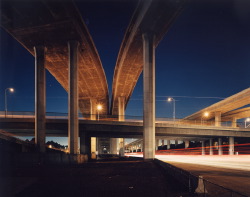
John Humble received a B.A. in philosophy from the University of Maryland and an M.F.A. from the San Francisco Art Institute. His large-scale color photographs of the ironies and paradoxes of the Los Angeles landscape have been exhibited and published internationally. His work is in numerous collections including the Corcoran Gallery of Art, the National Museum of American Art, the Smithsonian Institute, the Library of Congress, LACMA, the San Francisco Museum of Modern Art, and the J. Paul Getty Museum.